



If you notice any errors in the translations, remember:
"In the Legion, of the 144 languages, there is only one language: understanding each other."
About Legion'Arts
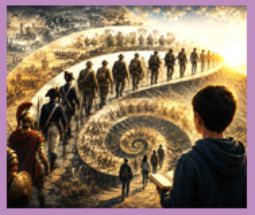
Solidarity in the French Foreign Legion
By Louis Perez y Cid
Solidarity is not born of joy. It is born of pain. We feel closer to those with whom we have suffered than to those with whom we have succeeded. Happiness flatters the ego. Adversity, however, forges bonds between men. In every collective victory, a touch of bitterness creeps in. Each person assesses their contribution, compares themselves, sometimes feeling wronged. Families are torn apart over inheritances, groups fragment after success, movements disintegrate once power is seized. Triumph divides. Misfortune unites.
The cohesion of a core group is forged elsewhere, in the memory of a shared ordeal. It is there that the individual fades into the background, giving way to the body. In the French Foreign Legion, this memory has a name: Camerone.
It is not a happy myth. It is a defeat, an agony, a loyalty unto death. But this is precisely why it is the foundation of Legionary solidarity. Victory is not celebrated here, but sacrifice. Not success, but loyalty in the face of adversity.
The etymology states it plainly. Sympathy and compassion mean "to suffer with." In the Legion, solidarity is not an abstract feeling. It is a lived experience, passed down, and remembered. It is the invisible bond that unites those who have fallen, those who still suffer, and those who continue to serve.
Read more...
Views of the Elders
Letter from My Garden
There was a time, in the 1970s, when our dear friend, the late Alain Gandy, wrote a much-loved column in "Képi Blanc" entitled "Letter from Elsewhere." Later, among those writing on the "Legionnaire-Officers" blog, Antoine Marquet, in a way, took up the mantle with his "Letter from Elsewhere," written from his residence in Portugal, the country of his origins and his new home in Lisbon. For my part, inspiration often strikes me when I find myself alone in my garden, letting my thoughts wander. So, I gladly offer this "Letter from My Garden," a way for me to talk about this and that, about what comes to mind and that I wish to share.
I remember my compulsory school readings from my early childhood: the writings of Voltaire, who asserted that "a garden is not simply a plot of land, but that it is essential to understand that cultivating one's garden is a metaphor, a rich and complex symbol...". Thus, cultivating one's garden meant turning to concrete, pragmatic action, far removed from abstract speculations and partisan ideologies in a world rife with misfortune. Leibniz, on the other hand, adopted an optimistic view, declaring his generous opinions, full of good intentions: "All is for the best in the best of all possible worlds..."—a harsh test where action becomes a refuge, a means, like any other, of finding, despite everything, a form of meaning, however questionable it may be in light of what the world offers us today. Read more...
Reflexions
A “New Cold War”?
“The silence of slippers is more dangerous than the sound of boots.”
By Louis Perez y Cid
The war in Ukraine has shattered a persistent illusion: that of a Europe definitively removed from the history of power relations.
Beyond the fighting, a long-term confrontation has taken hold between the West and Russia. A confrontation destined to last, with no quick solution or new security order on the horizon.
However, a major war between Russia and NATO remains unlikely. Nuclear deterrence continues to play its role, solidifying red lines and preventing escalation into all-out conflict. But the absence of open war does not mean peace.
Because another war is already here. More discreet, more diffuse. It unfolds in the gray areas: limited military pressure, cyberattacks, disinformation campaigns, sabotage, attempts to destabilize European societies. A “new Cold War” has taken hold, and we are fully involved in it.
Consequently, one question keeps recurring: does France have enough soldiers? Contrary to popular belief, the answer is generally yes.
The French Army has sufficient personnel for this type of confrontation, provided it fully utilizes all its resources. Comparing our situation to the Ukrainian war of attrition is misleading. France is operating within a collective framework, that of NATO, for the time being, and its mission is not to sustain a protracted war, but to deter, contain, and react swiftly. The active-duty army forms its core. Alongside it, the reserve is becoming essential, particularly for the protection of the territory and the reinforcement of forces in the event of a crisis. The planned doubling of its personnel by 2030 is a major asset, provided that real resources are allocated to it. Read more...
The war in Ukraine has shattered a persistent illusion: that of a Europe definitively removed from the history of power relations.
Beyond the fighting, a long-term confrontation has taken hold between the West and Russia. A confrontation destined to last, with no quick solution or new security order on the horizon.
However, a major war between Russia and NATO remains unlikely. Nuclear deterrence continues to play its role, solidifying red lines and preventing escalation into all-out conflict. But the absence of open war does not mean peace.
Because another war is already here. More discreet, more diffuse. It unfolds in the gray areas: limited military pressure, cyberattacks, disinformation campaigns, sabotage, attempts to destabilize European societies. A “new Cold War” has taken hold, and we are fully involved in it.
Consequently, one question keeps recurring: does France have enough soldiers? Contrary to popular belief, the answer is generally yes.
The French Army has sufficient personnel for this type of confrontation, provided it fully utilizes all its resources. Comparing our situation to the Ukrainian war of attrition is misleading. France is operating within a collective framework, that of NATO, for the time being, and its mission is not to sustain a protracted war, but to deter, contain, and react swiftly. The active-duty army forms its core. Alongside it, the reserve is becoming essential, particularly for the protection of the territory and the reinforcement of forces in the event of a crisis. The planned doubling of its personnel by 2030 is a major asset, provided that real resources are allocated to it. Read more...
Facts
Veterans' Associations Facing the Challenge of the 21st Century
Christian's article, "Dare to Think Differently," encouraged a break with entrenched certainties and the acceptance that reflection on veterans' associations and veterans' associations can no longer be satisfied with dogmas inherited from the past. It paved the way for a necessary debate, based on questioning and intellectual courage.
Antoine's text, which follows, continues in this vein but goes further by confronting the stated principles with the concrete realities of veterans' associations in the 21st century. Its author highlights the contradictions of a discourse that claims to revitalize while refusing to adapt to social, human, and territorial changes.
This is neither about denying the heritage nor weakening the Legionnaire identity, but about remembering that an institution that demands adherence without freedom and loyalty without listening risks isolation. This contribution is intended as a clear-eyed warning, in service of vibrant, useful associations faithful to the spirit of fraternity they claim to uphold.
Louis Perez y Cid.
Between Dogma and Reality
By Antoine Marquet (Lt. Colonel TE – er)
The text currently circulating, penned by a general officer, paints a picture of veterans' associations that seems frozen in the cement of the last century. In 2026, as the world has shifted towards hyper-connectivity, mobility, and individual autonomy, this project of "taking back control" resembles more of a semantic utopia than a concrete response to the realities on the ground. Read more...
Literary Explorations
“Daddy, Why Are You Leaving?” Why is this children’s book on our site?
By Louis Perez y Cid
“Daddy, Why Are You Leaving?” is a children’s book written by a young author. It has its rightful place on our site primarily because its story is deeply intertwined with our own.
Its author, Marion Maloigne, is a fellow service member of the French Air Force. Like so many service members, she had to deploy, leaving behind what she held most dear: her family. As a mother, she experienced the separation not only with her adult heart, but also through the eyes of her child.
From this ordeal, a certainty emerged. By blending her own experience with her passion for literature, she chose to write for children. For those who are waiting. For those who feel the absence without always being able to name it. For our children.
“Every day, hundreds of men and women are sent far from home. Of course, we think of them and support them, but what about those who stay behind? What about those little ones who suffer in silence?
As a mother, I saw the terrible sadness in my little boy’s eyes. What a heartbreaking ordeal for a parent to witness this powerful rift taking root in the hearts of our children. I couldn’t leave my son in such a heavy sorrow, and it’s thanks to these kinds of little stories that I was able to help him heal.”
Marion Maloigne Read more...
All this is happening above our heads
Our Atmosphere and the Greenhouse Effect. 1/2
By Michel Gravereau
Not a day goes by without hearing in the media that this or that event is due to "global warming." It's a convenient scapegoat.
Undeniably, the warning lights are flashing red, and despite the good decisions made by some, bad habits persist. The latest report indicates a slowdown in the reduction of greenhouse gas emissions for France in 2025 and a significant increase in emissions for the United States. France accounts for only 1 percent of global emissions.
I would like to remind you that scientists' concern about global warming is not new, since as early as 1873, the World Meteorological Organization (WMO) was already holding meetings on the subject. This would lead much later to the first Earth Summit, held in Rio in 1992.
At the time, Mr. Diesel hadn't invented his engine, and airplanes weren't crisscrossing our atmosphere. Let's try to get a clearer picture of our Earth's atmosphere and what we call greenhouse gases.
How far does the Earth's atmosphere extend?
Don't miss any of our publications and creations!
WHO WE ARE
Légion’Arts is an independent publishing house created by former legionnaire artists: preserving and sharing the memory of the Foreign Legion through authentic, human, and inspiring works. Every legionnaire has a voice. With Légion’Arts, these stories become a collective memory, accessible to all.