




All this is happening above our heads
Jupiter
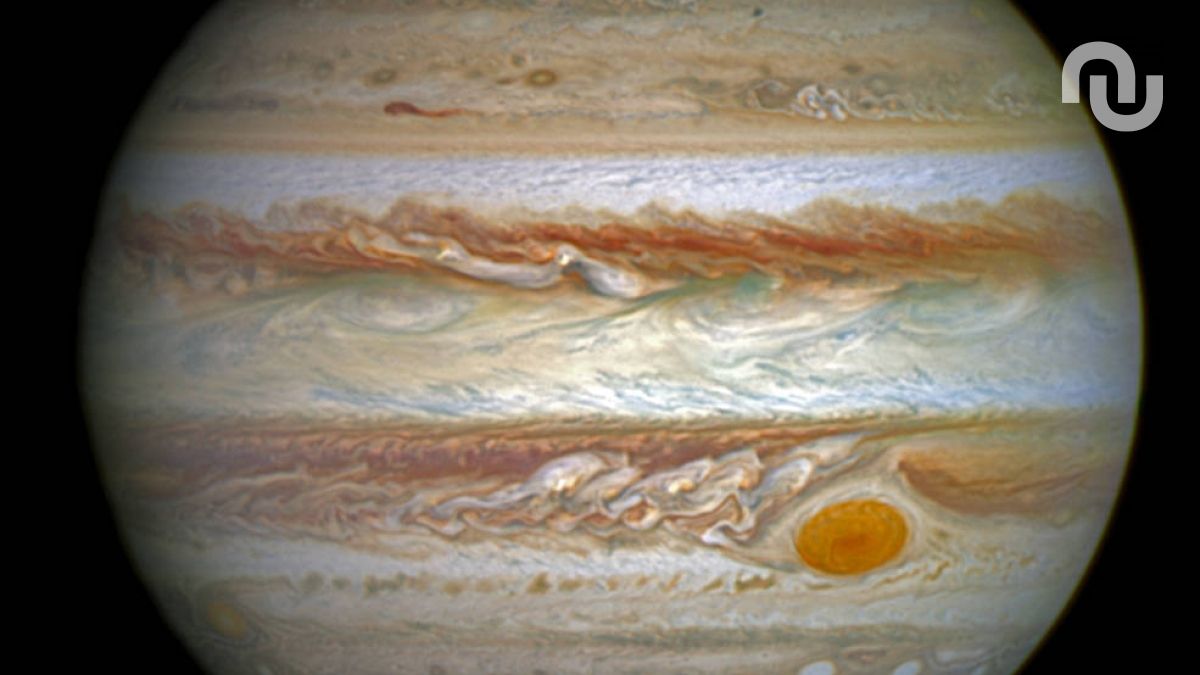
Jupiter, the largest planet in the solar system.
Jupiter easily wins the title of largest planet in the solar system. Its diameter at the equator, 142,800 km, is more than 11 times that of Earth (12,760 km), giving it a volume equivalent to 1,400 times that of our planet. Only Saturn, with its 120,600 km diameter at the equator, could hope to rival it, but even then, Jupiter remains undefeated. It is, however, still modest compared to the Sun, whose diameter is nearly 10 times greater.
Jupiter, a true giant. It is not for nothing that it bears the name of the father of all the gods in Roman mythology.
To get an idea of the size difference between Jupiter and Earth, imagine that Earth is represented by a cherry; Jupiter would be a soccer ball (22.4 cm). The Sun, on the other hand, would be a sphere 2 m in diameter.
Distance from Jupiter.
The Earth is considered to be on average 150 million km from the Sun. This distance is called the Astronomical Unit (AU).
Jupiter is 5.2 AU from the Sun, or approximately 778 million km.
For us observers, given the orbits of Earth and Jupiter, Jupiter can be closer to the Sun, in opposition, which is the case right now. It is then 778 – 150 = 628 million km away.
Or it can be behind the Sun. This is called superior conjunction. At that time, it is 778 + 150 = 928 million km away.
As you can see, its image in the eyepiece of a telescope is much larger at opposition. In this case, considering its size and distance, it is the fourth brightest object in the sky, after the Sun, the Moon, and Venus.
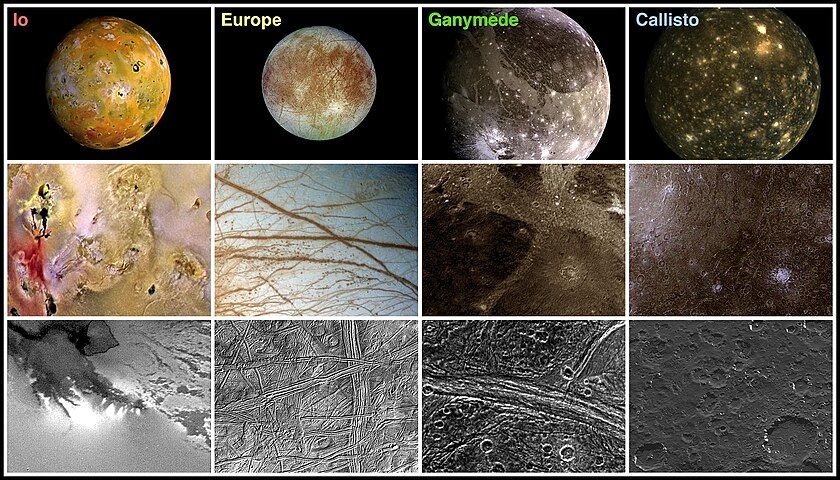
Take advantage of this time of year to observe Jupiter. Even with binoculars, you'll see the four "Galilean" moons, those discovered by Galileo in 1609.
Planetary System
The Jovian system is a veritable mini solar system. In 1609, Galileo discovered the four moons: Io, Europa, Ganymede, and Callisto. By 1993, we had counted 16 thanks to telescopes. But in-situ probes have now identified more than 70.
Observing Jupiter
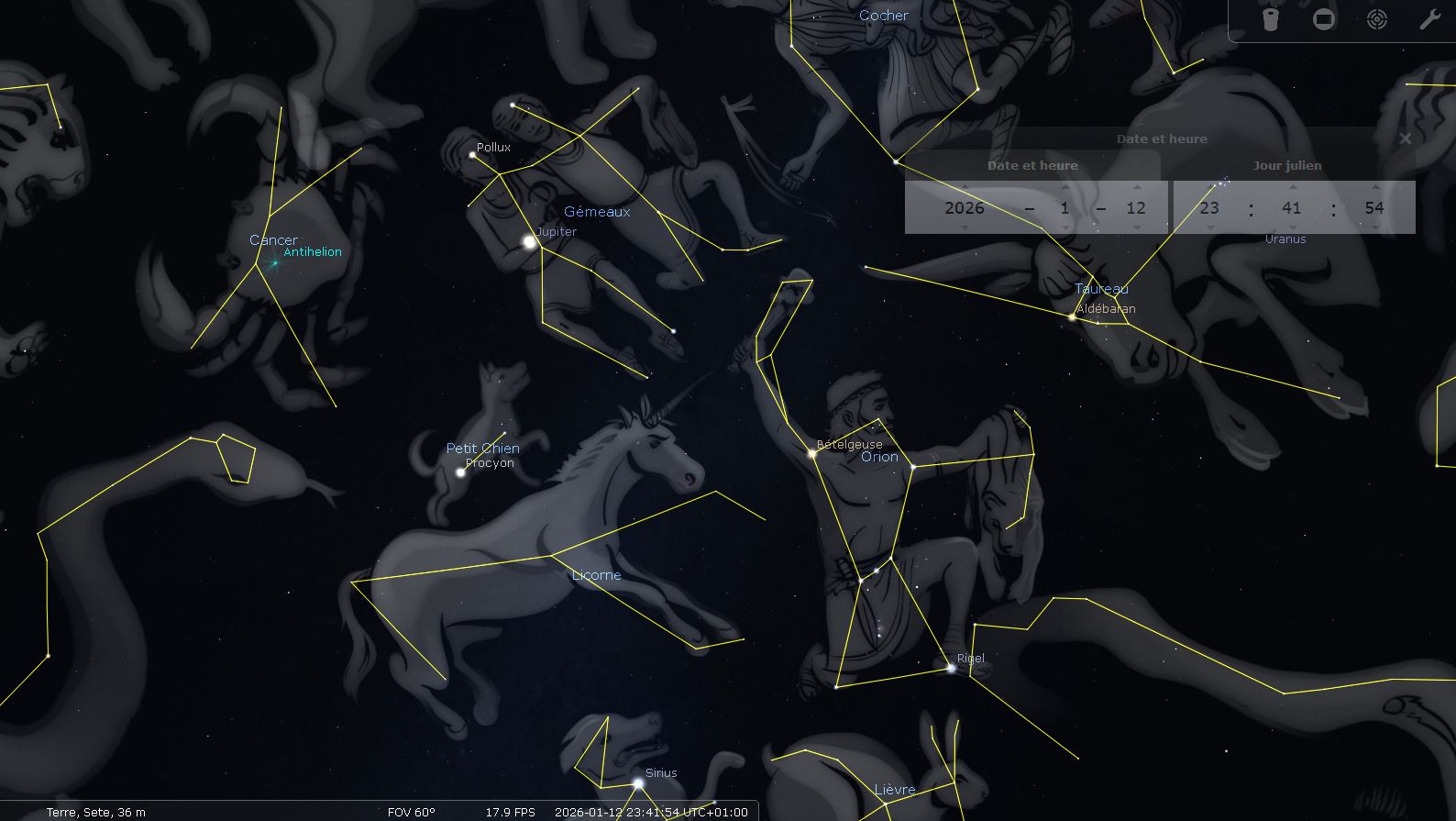
In the early evening, if you look towards the eastern horizon, you'll see the large constellation of Orion in the sky, easily recognizable by its trapezoidal shape. At its center, three stars, from left to right—Alnitak, Alnilam, and Mintaka—appear perfectly aligned. I've already mentioned this alignment, which is similar to that of the pyramids at Giza. To the left of Orion, slightly above, you will find the constellation Gemini, marked by Castor and Pollux. Below Pollux, a very bright point illuminates the sky: Jupiter, the largest planet in the solar system.
Jupiter's Rings
Ring
For most people, when you mention a ringed planet, only one answer comes to mind: Saturn. Admittedly, for a long time this was the only valid answer. Because from Earth, of course, even with large telescopes, it is only possible to see rings around Saturn. But the various probes launched in recent years have allowed us to better discover and understand our solar system.
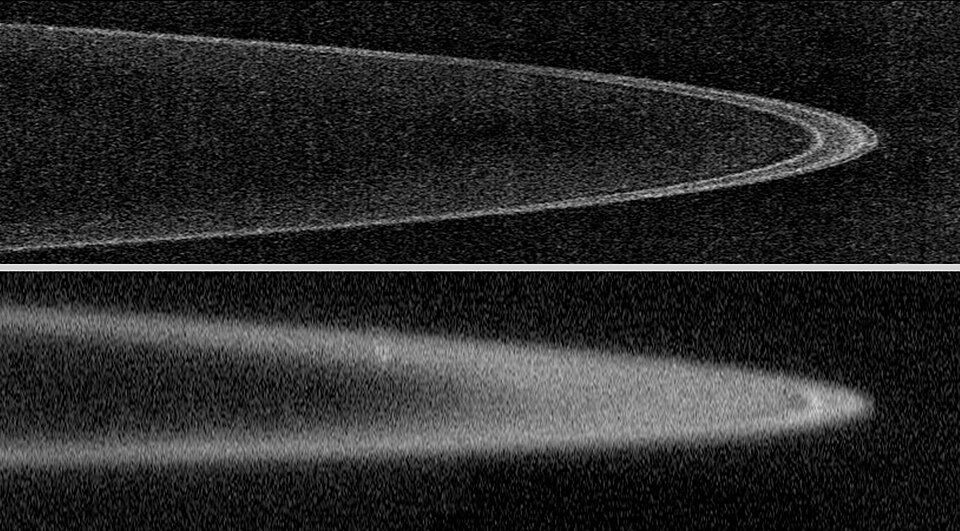
Thus, Jupiter has a ring discovered in 1979 by the Voyager probes. These rings were theorized as early as 1974 when the Pioneer 11 probe measured a drop in the density of magnetosphere particles between 50,000 and 55,000 km from the planet.
It is located 57,000 to 210,000 km above the cloud tops.
The rings are no more than 30 km thick. This ring is composed of dark, reddish particles, on the order of a few thousandths of a millimeter.
This was a huge revolution in our understanding of our solar system.
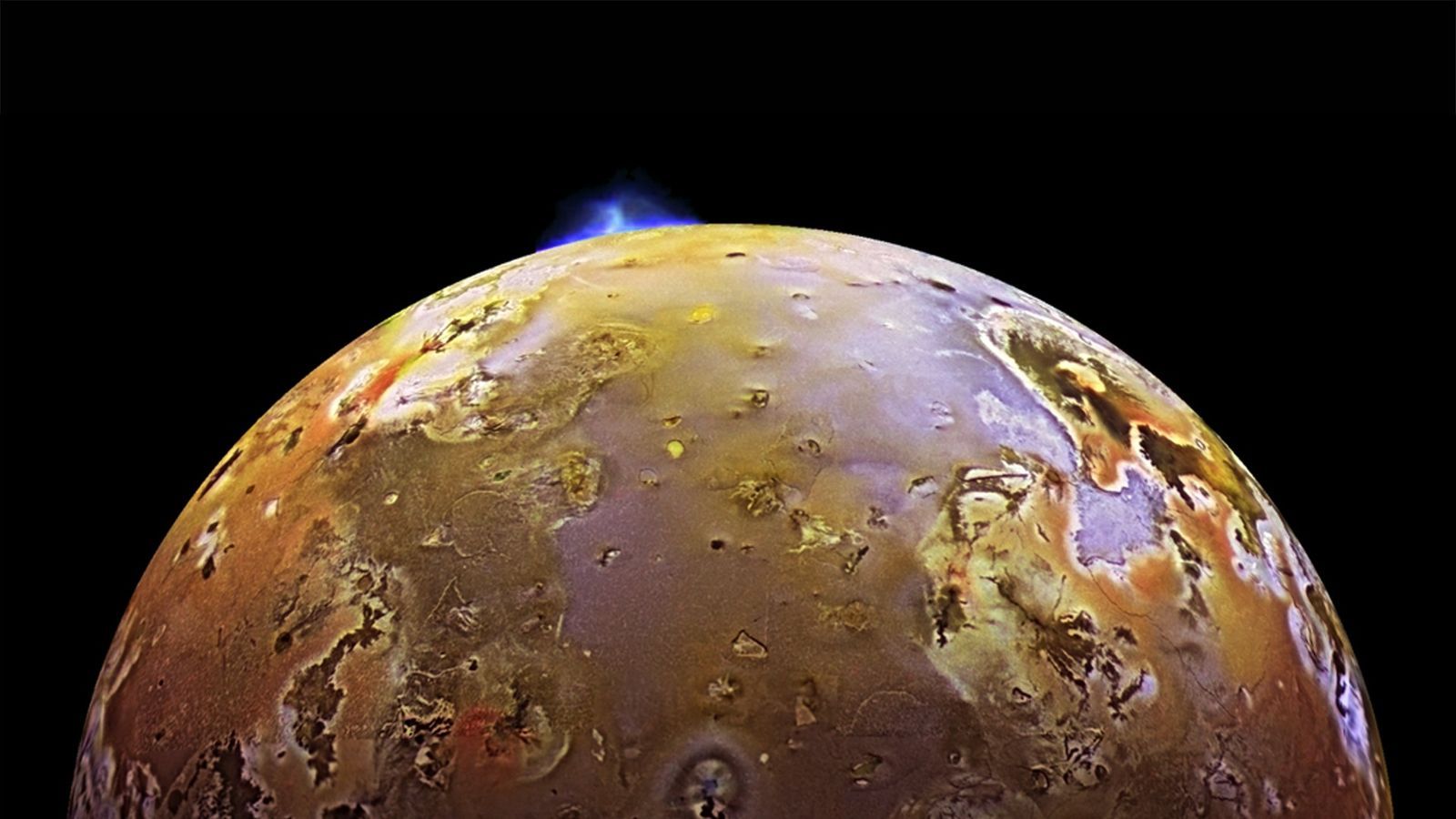
A few days later, thanks to the same probe, another piece of the puzzle fell: while it was thought that only Earth had active volcanoes, upon arriving near Jupiter's moon Io, the probe discovered 12 active volcanoes erupting.
The Americans, seeing the close-up images of Io, nicknamed it the evocative "Pizza."
A few days later, thanks to the same probe, another piece of the puzzle fell: while it was thought that only Earth had active volcanoes, upon arriving near Jupiter's moon Io, the probe discovered 12 active volcanoes erupting.
The Americans, seeing the close-up images of Io, nicknamed it the evocative "Pizza."
Jupiter's Movements.
Rotation.
You remember that the Earth rotates on its axis every 24 hours. Jupiter, 11 times larger than our planet, rotates in 9 hours and 56 minutes. A veritable spinning top. This violent rotation causes it to be flattened at the poles. Its circumference at the poles is 4,640 km less than that at its equator.
In France, without us even realizing it, we are carried along by the Earth's rotation at a speed of 800 km/h. At Jupiter's equator, it's 45,000 km/h.
Revolution.
The Earth takes 365 days and 6 hours to orbit the Sun. Jupiter completes its revolution in 4,332 days, or just under 12 years.
Density.
While the Earth has a density of 5.51, Jupiter's is 1.31, and Saturn's is 0.7.
The atmosphere of Jupiter is composed of 82% hydrogen and 17% helium.
Much farther from the Sun than Earth, its temperature hovers around -140°C.
The atmosphere of Jupiter is composed of 82% hydrogen and 17% helium.
Much farther from the Sun than Earth, its temperature hovers around -140°C.
The Great Red Spot
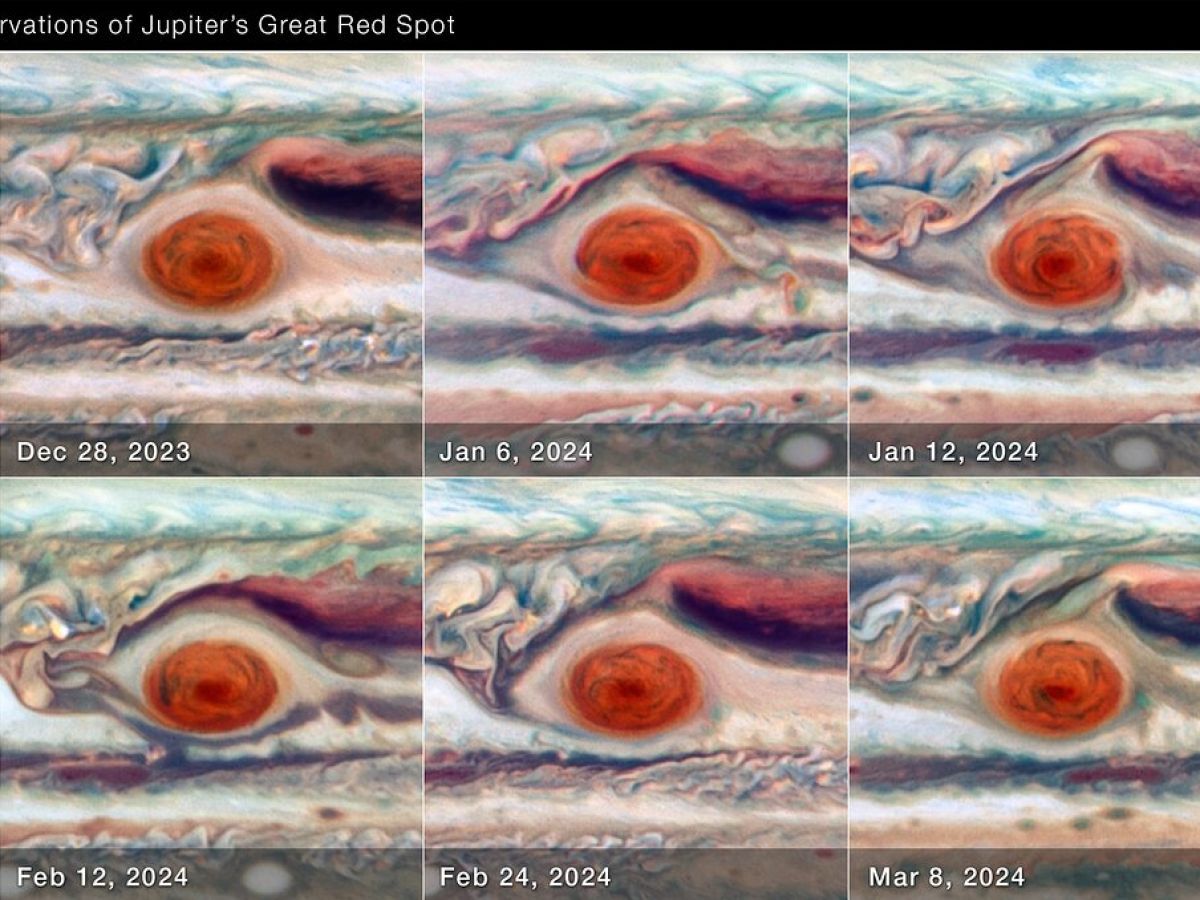
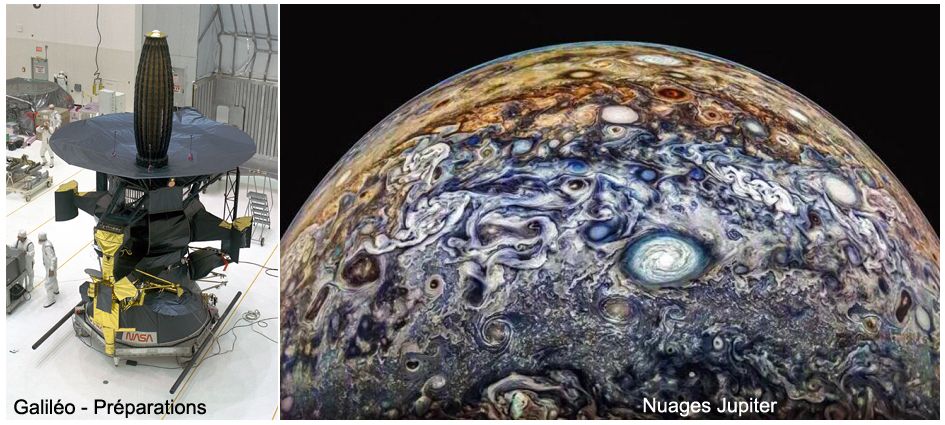
The most extraordinary feature on Jupiter remains the Great Red Spot. It was discovered in 1664 by the Englishman Robert Hooke.

It is an immense cyclone, 26,200 km long and 15,000 km wide.
It is shrinking by 100 km per year.
Its clouds take 6 days to complete a rotation. Its formation and future remain a great mystery.
It is shrinking by 100 km per year.
Its clouds take 6 days to complete a rotation. Its formation and future remain a great mystery.
Exploration of Jupiter.
Five American space probes have visited our giant planet Jupiter over the past thirty years. The first, Pioneer 10 (launched in 1972), passed 130,000 km above its clouds. The next spacecraft, Pioneer 11 (1973), flew past it at a distance of 43,000 km. Then came Voyager 1 and Voyager 2, which, in 1979, flew by its main natural satellites: Amalthea, Io, Europa, Ganymede, and Callisto.
Finally, in 1989, the Galileo probe began its journey to Jupiter. In 1995, it deployed a probe into Jupiter's atmosphere and entered orbit around it.
Jupiter is the largest planet in the solar system, and its relative proximity allows us, with good telescopes, to admire it and see some details such as its equatorial bands or the Great Red Spot. Easy to spot in the sky thanks to its brightness, it will shine brightly throughout the winter and spring. Get your binoculars or telescopes ready!
Upcoming Events
Starting today, I am launching a new permanent section that will appear at the end of this text.
This section will inform you about upcoming events in the fields of pure astronomy and space exploration.
Astronomical Events
January 30: Close conjunction of the Moon and Jupiter.
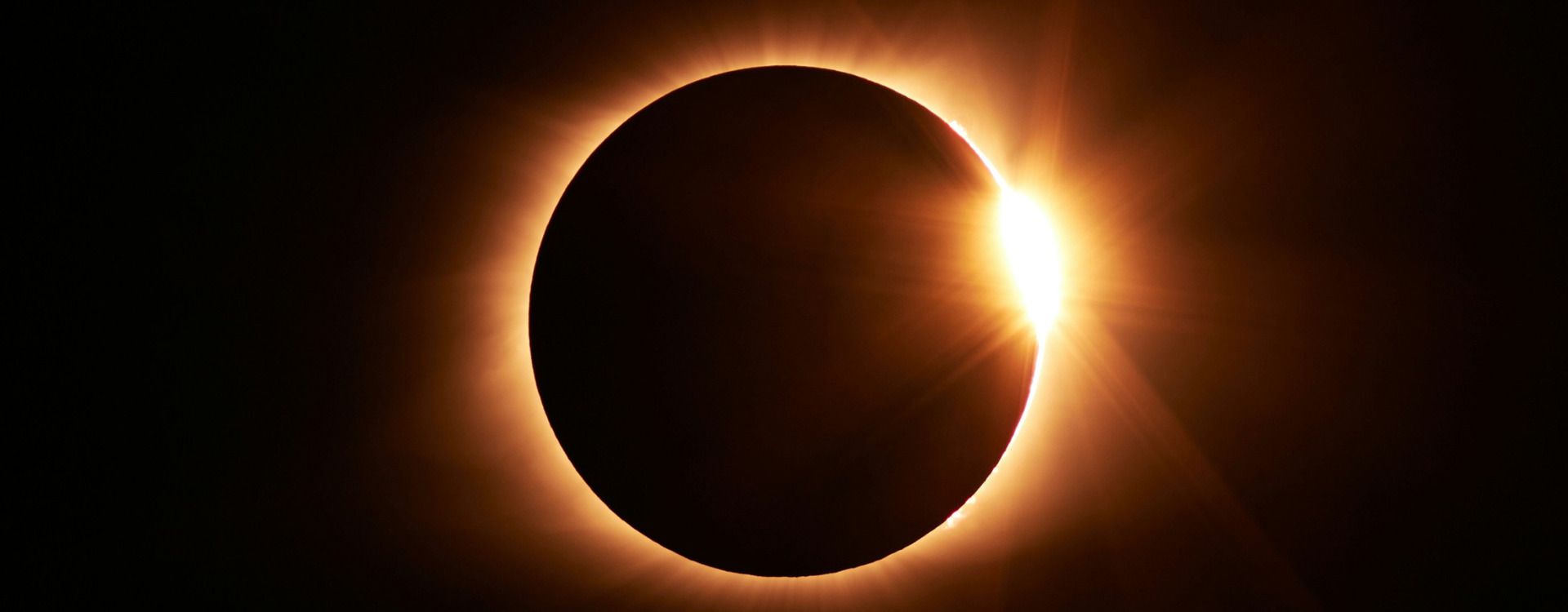
February 17: Annular solar eclipse, not visible from mainland France.
March 3: Total lunar eclipse, not visible from mainland France.
March 20: Spring equinox.
May 7 and 8: Sunset under the Arc de Triomphe from the Place de la Concorde.
May 9, 10, and 11: Sunset under the Arc de Triomphe from the Champs-Élysées roundabout.
June 21: Summer solstice.
July 31, August 1, 2, and 3: Sunset under the Arc de Triomphe from the Champs-Élysées roundabout.
August 3, 4, and 5: Sunset under the Arc de Triomphe from the Place de la Concorde.
August 12: Total solar eclipse, visible in its partial phase in mainland France.
Starting today, I am launching a new permanent section that will appear at the end of this text.
This section will inform you about upcoming events in the fields of pure astronomy and space exploration.
Astronomical Events
January 30: Close conjunction of the Moon and Jupiter.
February 17: Annular solar eclipse, not visible from mainland France.
March 3: Total lunar eclipse, not visible from mainland France.
March 20: Spring equinox.
May 7 and 8: Sunset under the Arc de Triomphe from the Place de la Concorde.
May 9, 10, and 11: Sunset under the Arc de Triomphe from the Champs-Élysées roundabout.
June 21: Summer solstice.
July 31, August 1, 2, and 3: Sunset under the Arc de Triomphe from the Champs-Élysées roundabout.
August 3, 4, and 5: Sunset under the Arc de Triomphe from the Place de la Concorde.
August 12: Total solar eclipse, visible in its partial phase in mainland France.
Perseid meteor shower.
August 28: Partial lunar eclipse in mainland France.
September 14: Venus appears behind the Moon.
September 23: Autumnal Equinox.
December 21: Winter Solstice.
Bear Meteor Shower.
Space Exploration
ISS Passage: From January 21 to 31, it is visible in the evening sky.
Artemis 2 Launch to the Moon: April or possibly February.
August 28: Partial lunar eclipse in mainland France.
September 14: Venus appears behind the Moon.
September 23: Autumnal Equinox.
December 21: Winter Solstice.
Bear Meteor Shower.
Space Exploration
ISS Passage: From January 21 to 31, it is visible in the evening sky.
Artemis 2 Launch to the Moon: April or possibly February.